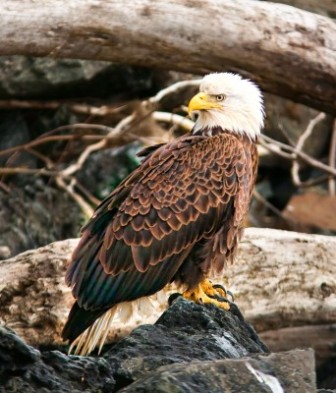
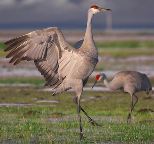
Bald eagles, trumpeter swans, sandhill cranes, Canada geese and millions of other migrating birds of prey, seabirds, songbirds and waterfowl make Alaska a land unparalleled for bird-watching. As of January 2011 the list of birds found in Alaska included 492 naturally-occurring species in 64 families and 20 orders. The key to great bird-watching is being at the right place at the right time. Alaska's vast tundra provides safe nesting territory for migratory species such as swans, geese, ducks and terns. The salmon streams, mountains, forests and seashores provide steady food for bald and golden eagles.
The willow ptarmigan was designated the official state bird of Alaska in 1955. Willow Ptarmigan are pheasant-like birds that resemble small grouse, weighing from 10.5 ounces to 24 ounces. There are three kinds of ptarmigan and all can be found in Alaska - the willow ptarmigan and rock ptarmigan (which are also found in Scandinavia, Russia, and northern Eurasia), and white-tailed ptarmigan (found only in North America). The famous red grouse of Scotland is a race of the willow ptarmigan. The Rock and Willow Ptarmigans look almost alike, since they have the same coloring and sport similar sizes. The Willow Ptarmigan have a larger bill and, if you can get this close, the Rock Ptarmigan appear to have black eyeliner.
There are plenty of loons in Alaska - five species to be exact. Theses "spirits of the wilderness" are a vital part of Alaska's wilderness and are known for the distinctive yodeling call of the male loon. Loons are fast, flying at speeds of up to 60 miles per hour, and are among the best diving birds in the world, with the ability to stay underwater for more than a minute. The entire state has loons of one species or another (common, yellow -billed, red-throated, Pacific and arctic). Common loons like larger lakes, and Pacific loons choose ponds and small lands. The common and yellow-billed loons are larger than the three other species. A loon's legs originate far back on its body, so they're not much good for walking. Loons rarely leave the water
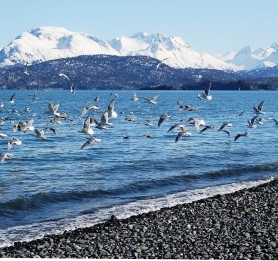
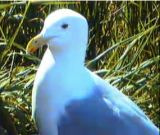
Three large gulls are commonly found in Alaska. These are the glaucous-winged, gull glaucous gull and herring gull in order of decreasing abundance. These gulls are closely related, and hybrids are not uncommon. Glaucous-winged gulls are the common "seagulls" familiar to many on the south coast of Alaska. Glaucous-winged gulls breed in Alaska from the British Columbia border to the end of the Aleutian chain and northward to Bristol Bay, western Nunivak Island, and the Pribilofs. Glaucous gulls breed along the coast of western and northern Alaska from the Yukon-Kuskokwim Delta to Demarcation Point on the Canada border and on several islands in the Bering Sea. Almost all features of reproductive biology of Interior herring gulls resemble those of glaucous-winged gulls. However, the food of Interior herring gulls is limited and consists mainly of fish. This may account for their lower numbers.
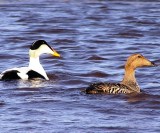
The eiders are sea ducks found across the arctic and subarctic zones of the northern hemisphere. All four of the world's eider species breed in Alaska, and many of these birds remain in the state's coastal waters during winter. The common, king, and spectacled eiders are among the largest ducks in North America. Steller's eiders are smaller and one of the most unique members of the duck tribe. The eiders are mostly arctic tundra nesters that remain in northern waters during winter and move toward nesting grounds as soon as the spring sea ice breaks up. Common eiders often nest in colonies along the coast, on barrier islands, and sand spits. The other three species are solitary breeders that usually nest on islands and peninsulas in tundra lakes and ponds. Spectacled Eiders were listed as ‘threatened’ in 1993 following a 96% decline in the western Alaska breeding population between 1971 and 1992.
Trumpeter swans and tundra swans are the two species of swans native to North America, both nesting in Alaska. The tundra swan was formerly named the whistling swan. A few whooper swans an Asian temperate region relative to trumpeters, are occasionally seen in the Aleutian Islands during winter. The trumpeter is the world's largest member of the waterfowl family, with males averaging 28 pounds and females averaging 22 pounds. Although less than two-thirds the size of trumpeters, tundra swans are often difficult to distinguish from their close relative when seen in the field. Adult tundra swans frequently, but not always, have a yellow spot on their black bill near the eye. Like all swans, the sexes have identical plumage, and both tundra and trumpeter swan adults are all white. However, in some Alaska locales, iron-rich marshes stain head and neck feathers a rusty color. One sure way to identify trumpeters is by their deep, French horn-like call, compared to the higher "whoop" of the tundra swan.
|
|