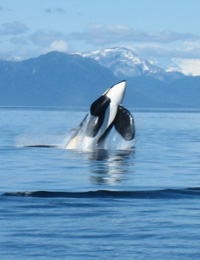
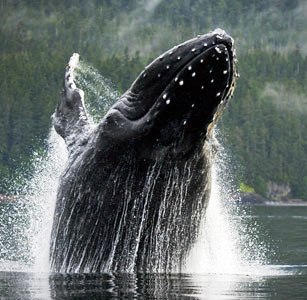
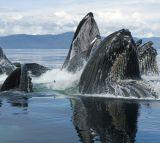
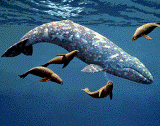
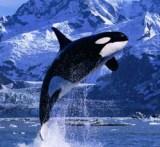
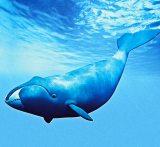
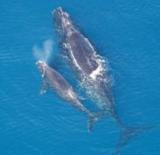
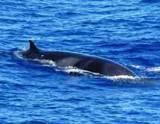
There are eight species of whales that frequent the cold and icy waters of Alaska. The Beluga, Humpback, Gray, Orca, Bowhead, Blue, Right, and Minke whales. Like all mammals, whales breathe air into lungs, are warm-blooded, breast-feed their young, and have some (although very little) hair. The whales' ancestors lived on land, and their adaptations to a fully aquatic life are quite striking. The body is fusiform, resembling the streamlined form of a fish. The forelimbs, also called flippers, are paddle-shaped. The end of the tail holds the fluke, or tail fins, which provide propulsion by vertical movement. Although whales generally do not possess hind limbs, some whales (such as sperm whales and baleen whales) sometimes have rudimentary hind limbs; some even with feet and digits. Most species of whale bear a fin on their backs known as a dorsal fin.
Alaskan waters boast a wide range of whale inhabitance. Some reside in these cold waters year round and some migrate for long distances returning in the summer months to feed upon the abundant sea life and to bear their young.
Beneath the whale's skin lies a layer of fat called blubber. It serves as an energy reservoir and also as insulation. Whales have a four-chambered heart. The neck vertebrae are fused in most whales, which provides stability during swimming at the expense of flexibility.
Whales breathe through blowholes, located on the top of the head so the animal can remain submerged. Baleen whales have two; toothed whales have one. The shapes of whales' spouts when exhaling after a dive, when seen from the right angle, differ between species. Whales have a unique respiratory system that lets them stay underwater for long periods of time without taking in oxygen. Some whales, such as the Sperm Whale, can stay underwater for up to two hours holding a single breath. The Blue Whale is the largest known animal that has ever lived, at up to 93ft long and 180 tons.
The skin of whales has evolved hydrophilic properties. Its surface is covered with microscopic pores surrounded by nanoridges. Between these ridges there is a rubber-like gel which is excreted from the gaps between the skin cells. This gel contains enzymes that attacks microbes, and the edge of the ridges makes it hard for smaller organisms to get attached.
Ask people what animal they most want to see in Alaska, and the two most common answers are bald eagles and whales. Whales begin their migration from the warm waters of Mexico in February arriving in Alaska waters in April. Various species of whales can be seen throughout Alaska during the months of May through September. Across Alaska, nearly all the whales migrate south between September and May, but some non-mating males do frequently stick around Silver Bay, in Sitka, year-round.
Juneau's whales are like snowbirds everywhere -- they spend the beautiful summer months here at home but head to Hawaii for the cold winter months. But when they are here, they are the most welcome of neighbors.
Whaling is a huge part of Eskimo culture because it has many uses. It's a major food source, with the meat rich in niacin, iron, and protein, and the skin is rich in calcium. Even the tongue and other organs are eaten. Nothing is wasted. The bones were used for housing equipment, and the huge vertebrae were used for seats. Baleen was used for boot insulation. The stomach and bladder were, and still are, used for drums. Whaling is a huge event every season. Everyone is involved in the whole whaling process. The whole community helped haul in the whale, butcher it, cook it, and distribute it. It was, and is, elaborately celebrated at the beginning and ending of the whaling season. The whaling captain and his family feed the whole community after the first hunt. They play games, dance, and eat for three to five days. Nalukatak is a blanket toss celebration which occurs after the hunting season is over. During this June celebration, captains plan for the next season's harvest. This lasts three to five days also.
|