|
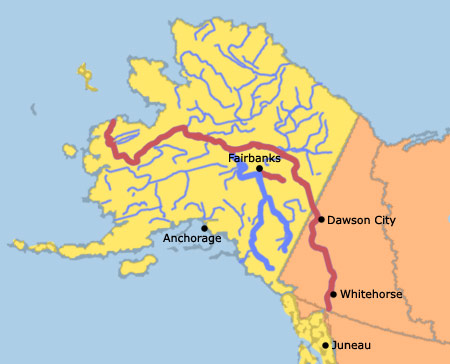
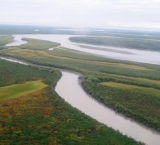
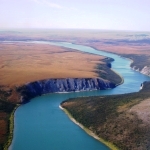
The Yukon is the nation's third longest river; at 1,980 official miles from its source in the Nisutlin River of the Yukon Territory to its mouth in the Bering Sea, it is outstretched only by the Missouri (2,540 miles) and the Mississippi (2,350 miles). In both average discharge at mouth (225,000 cubic feet of water a second) and drainage area (328,000 square miles), the Yukon River ranks fifth nationally. For comparison, that's right ahead of the Columbia in area drained and right after it in discharge. (The Columbia River also needs Canada to gain its rank; its source is in British Columbia.) Two Yukon tributaries also make the list. The Porcupine ranks 20th in drainage area, and the Tanana is number 16 for average discharge. The Tanana is one of four rivers on the USGS list that starts where a glacier ends; its official beginning, with the Nabesna River, is in meltwater from the Nabesna Glacier, 659 miles from its mouth. (I'm sorry to say that makes it the third-longest river on the list that starts and ends within one state. Longest is the Colorado River of Texas, which wanders 862 miles in our second-largest state.)
Another listed river starting at a glacier is the Susitna, which gathers enough water from the Susitna Glacier and its tributary streams to achieve 15th rank in discharge---51,000 cubic feet each second on average. Southcentral's other listed river is the Copper, 10th in volume of discharge, which begins in the Copper Glacier. Probably most Alaskan-sounding of all is the Kuskokwim, ninth in discharge, 17th in drainage area, and second-longest river within a single state at 724 miles. Its source is given as "South Fork Kuskokwim River at terminus of unnamed glacier." At least that lets us brag that Alaska has so many glaciers we haven't got around to labeling them all on the map. Texas can't top that one.
The Stikine takes honors in Southeastern. Its 56,000 cubic feet of water discharged to the sea every second gives it 13th rank in the category. The last of Alaska's rivers to make the list is the Nushagak, with 20th place in volume for the 36,000 cubic feet of water it discharges into Bristol Bay each second.
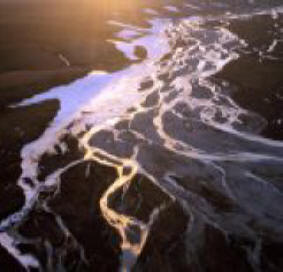
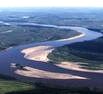
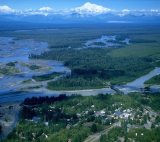
Bank erosion along the Matanuska River, a large braided river in southcentral Alaska, has periodically damaged or destroyed properties and structures for decades. Continued rapid population growth in one of the fastest growing areas in Alaska, coupled with the expense of erosion control measures, has elevated the issue for land managers and property owners. Understanding channel processes and variations in bank erodibility is needed to effectively manage areas near such active rivers.
King Salmon can be caught in many of Alaska rivers. The typical king salmon spends one year in fresh water before heading to the ocean then spends two to six years in the saltwater so they range from as little as 15 pounds up to the behemoths that are in the 100 pound range with the typical Alaska king ranging between 20 and 40 lbs. Hooking and landing a big king salmon is the dream of most of the fisherman who come to the Kenai Peninsula.
For peak Rainbow trout fishing in Alaska come anytime from mid August through the end of September. There are a lot of great options but the best of them are rivers that have huge red runs - the Kenai and Bristol Bay drainages like the Alagnak, Tikchik or Kvichak for those truly big bows.
Dolly Varden are members of the char family like brook trout, lake trout and of course, arctic char. Most Alaskan river systems have both resident and sea run dollies. The sea runs head for the ocean in mid June and we see them back in the river as the second run of red salmon are well into their run. Dollies are unique in that they are not 100% loyal to their birth river. In the Goodnews River, biologists captured Dolly Varden and implanted several fish with radio transmitters. The radio-tagged fish were tracked aerially throughout the year. Dollies tagged in the Goodnews River have been recaptured in the Aniak, Kulukak and north of the Yukon River.
Because of Alaska's massive glacier runoff and rainwater drainage, Alaskan rivers serve up more adventure than most anything you'd find in the Lower 48. From the Kenai Peninsula's Sixmile River to Denali's Nenana River, floating down the river is a unique nature experience. You hear the rush of water approaching, and suddenly you see them: the unmistakable caps of whitewater. Before you know it you're in the middle of the rapids, holding on tight as water splashes all around.. Or perhaps you'd prefer to skip the rollercoaster ride and relax on a gentle float through a silent stretch of pristine Alaska wilderness, as nature goes about its business. Or you might choose a saltwater paddle instead, quietly slicing through the waves as your kayak draws near to a rookery of Puffins or raft of Sea Otters. Whether you choose a whitewater adventure, a scenic float trip, or a sea kayaking tour, most visitors, regardless of age or ability, will enjoy their time on the water. These trips are some of the best ways to connect with nature in Alaska!
|