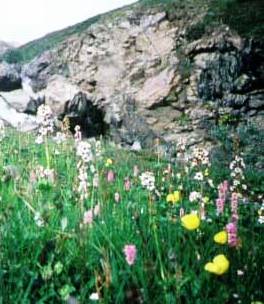
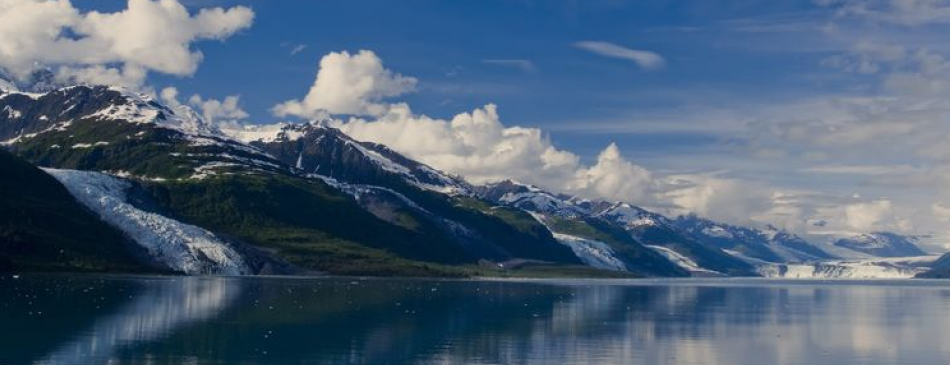
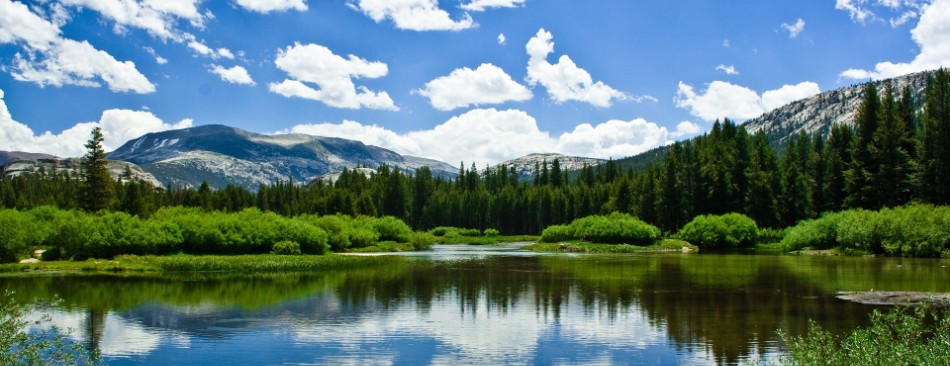
Ecosystems in Alaska range from grasslands, mountains, and tundra to thick forests, in which Sitka spruce (the state tree), western hemlock, tamarack, white birch, and western red cedar dominate the landscape. Various hardy plants and wild flowers spring up during the short growing season on the semiarid tundra plains.
Many of the plants in Alaska produce spectacular wildflowers and colorful foliage, providing excellent opportunities to enjoy native plants from spring through autumn. Native wildflowers have become an important component of commercial and home landscapes, golf courses, and highway and mine revegetation projects. This is due, in part, to public concerns about the environment and plant and water conservation. Landscape architects have identified water conservation and low maintenance landscapes as the most significant trends in landscape design in the 1990s. These trends have resulted in an increased demand for native plant materials.
Native wildflowers are “generally more tolerant of the region’s climatic irregularities and require less attention, water, and fertilizer. They also, if properly established, will self-sow and persist year after year. Wildflowers in the landscape have resulted in a 25 to 30% savings in annual mowing or maintenance costs when compared to plantings of turf grasses. Since 1987, wildflowers have been specified for use in all federal highway landscape projects. In Alaska, Icelandic poppy was sown along highways,
but this species was eliminated in 1989 because it is not indigenous to Alaska.
The Alaska Fireweed is "Alaska's Calendar." Atypical of most flowers, the Fireweed blooms from the bottom petals and works its way up. As the petals open over a course of a few weeks, it eventually becomes "topped out" and Alaskans regard this as the sign that summer is nearly over. Vast fields of Fireweed can be seen throughout Alaska and are the perfect roadside decoration. Fireweed comes in two varieties: the standard Fireweed plant and Dwarf Fireweed. Dwarf Fireweed typically grows in more arctic and harsh areas of Alaska while the standard Fireweed can grow as high as five and six feet in the warm and sunny climates of the Kenai Peninsula.
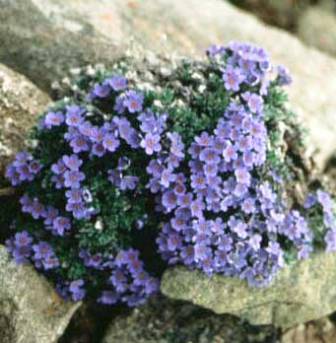
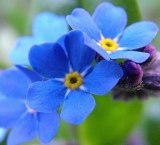
Another favorite wildflower is the Forget-me-not, which also has the official title as the Alaska State Flower. The Arctic version of the flower is the more common variety in Alaska and it coloring is apt for the state. Consisting of a small five-petaled blue bloom with a yellow "eye," the Forget-me-not is of the same coloring as Alaska's State Flag. The plant is known to be very hearty and can grab hold in sandy and gravelly soil. It flourishes as far north as Barrow on the Arctic Ocean.
Tall Jacob's Ladder wildflowers grow in fields, beside streams and in wet meadows throughout most of Alaska. Jacob's Ladders sprout in May and bloom in early June. Each stem usually produces several small blue flowers.
Perhaps the most exotic flower is found in the
South-central area of Alaska including the Kenai Peninsula. The Chocolate Lily, also known as Indian Rice, is a beautiful rich brown color. Although the odor is considered unpleasant, the bloom truly looks chocolately enough to eat. The plant can grow up to 24 inches tall and thrives best in moist lowland meadows. A flower that often grows along side of the Chocolate lily is the Wild Iris. Blooming in mid to late June, the Wild Iris often grows in large fields and meadows with high water content. One of the best viewing areas for both the Wild Iris and the Chocolate Lily is the "Eklutna Flats" directly south of the village of Eklutna along the Glenn Highway. Like the Lily, the Wild Iris is best viewed in early summer and has a short bloom period.
Another prolific bloom is the Nootka Lupine. The Lupine, with its deep blue and purplish coloring, can easily be spotted throughout Alaska. This plant can also grow quite tall (nearly five feet) and is hearty enough to grow on gravel bars, dry slopes, as well as meadows. Often seen blooming along the highways, the Lupine, like the Fireweed, is a popular photography subject. Areas around the Seward Highway near the turn off for Portage Glacier are good for photographing Lupine with the Turnagain Arm and Kenai Mountains as a breath-taking backdrop.
Mountain Harebells are alpine flowers and can often be found on rocky slopes of Alaska. In harsh alpine conditions, Mountain Harebells are quite small and often produce a single flower. The overall height, including the stem is only 1 to 3 inches. Laying low on the ground and with tiny leaves, Mountain Harebells are well adapted to dry and windy climate. At lower elevations, they can afford to be a little taller and can produce several flowers per plant.
|
|