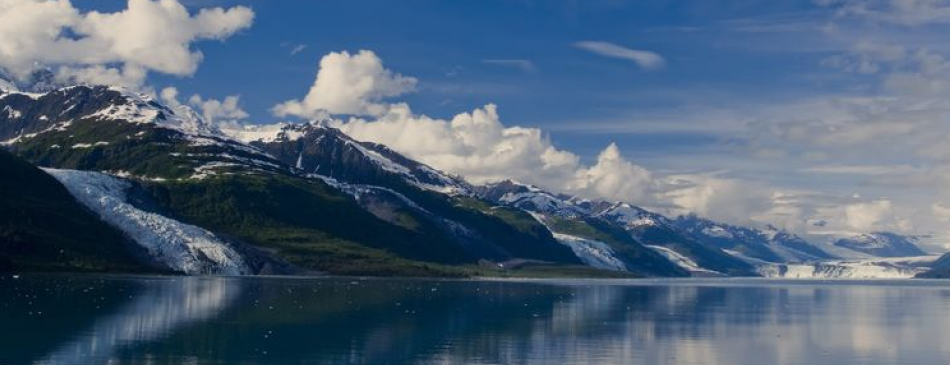
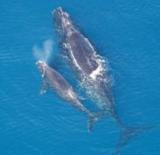
Alaska has more coastline than any other state. It is also the only state that borders three seas, the Arctic Ocean, Pacific Ocean and Bering Sea. Coastal Waters around Alaska offer excellent opportunities to see marine life including whales, dolphins, porpoise, seals, sea lions, fur seals, walrus, sea otters, and more.
The sea otter has the thickest fur in the animal kingdom and depends on air trapped in the fur to help them maintain their body temperature. A member of the weasel family, the sea otter is one of the only mammals to use tools, often relying on small rocks or other shellfish to pry prey from rocks, and hammer or pry open their food. You're sure to see sea otters on a trip into Prince William Sound. They're bigger than their freshwater counterparts and eat huge amounts of seafood. They divide their days between grooming their fur and eating. They live from 10 to 20 years.
Harbor seals eat fish, and you'll see them swimming gracefully in the water. On land, it's a different story. They're really too fish-like to be able to maneuver around like most other mammals. So when they're out of the water, they tend to stay in groups for their protection. Harbor seals are found on icebergs in June when they give birth, and in August when they molt.
Stellar Sea Lions are the "Lion of the Sea" . They earned
the name because of their distinctive bellowing roar. As the largest sea lions, males can reach eleven feet in length and weigh up to 2,200 pounds. The Steller Sea Lion uses its flippers as rudders for steering, and travels up to 250 miles from home in search for food. Out of the water, Sea Lions look like couch potatoes. Or even like couches. In the water, they're graceful and beautiful. They tend to be big and brown, whereas seals are black or gray. Sea lions' long flippers give them some mobility on land.
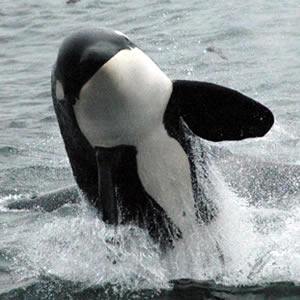
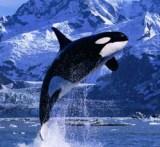
You may well see black-and-white dall porpoises running alongside your boat out in Prince William Sound. They kick up a rooster tail of spray when they surface and are enthusiastic bow riders on boats. They're very fast -- and black, with a white belly. The coloring is similar to an orca, but they're smaller - and don't have the very large dorsal fin of an orca whale. They can travel up to 50 mph. This porpoise has a stocky, black body with large white sections on the flanks and belly. The head is small and beakless. They are 6 to 8 feet long, weighing up to 400 pounds. They are commonly seen offshore and inshore from southern California to Alaska. Being a deepwater animal it comes close to shore where their are canyons or deep channels. Sightings are common in Hecate Strait, Queen Charlotte Strait, Juan de Fuca Strait, and exposed seaways like Queen Charlotte Sound, Dixon Entrance and Fitzhugh Sound.
The genus name for the walrus, Odobenus (meaning tooth-walker), refers to one of their most prominent characteristics, their tusks. These tusks, which are elongated upper canine teeth, are present in both males and females. The body form is basically like a sea lion, and they have flexible hind flippers that can be rotated forward, a thick, heavy neck, and a broad muzzle that bears a heavy, bristly moustache. They are huge animals. Adult bulls often approach 2 tons in weight, and the females may exceed 1 ton. The tusks are used for fighting, for climbing on both land and ice, and for emergencies of various kinds. A female walrus was observed literally demolishing a heavy piece of ice to free her calf, which had fallen into a crevasse. The tusks were as effective as a pick-axe.
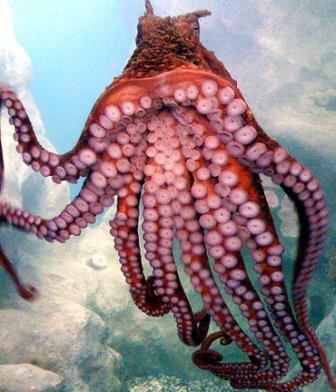
The giant Pacific octopus is an intelligent creature. In laboratory tests and aquariums, it has been able to solve mazes very quickly, unscrew jar lids to retrieve food inside the jar, and even mimic another octopus in a different tank. The giant Pacific octopus is one of the largest species of octopods. Its reddish-brown body, called the mantle, plus four pairs of arms, measure on average about 16 feet long from arm tip to arm tip. The record weight for a Pacific giant is 600 pounds, but most weigh about 50 to 90 pounds. Newly hatched young are the size of a grain of rice.
Salmon sharks take a bite out of Alaska's salmon runs, but they're not at the top of the food chain when fishing charter boats are in the area. Gulf of Alaska anglers have caught salmon sharks averaging from 250 to 400 pounds and sometimes weighing over 700 pounds. Heavy tackle is needed for these edible sharks, which resemble great white sharks and leap like marlin when hooked.
In the North Pacific waters of Alaska there are five types of shrimp; Northern Pink, Humpy, Coonstripe, Sidestripe, and Spot shrimp. Alaska's shrimp, the Palandid family, is an odd bunch, being one of the few animals on the earth that change sex during their lifetime. They spend their early lives as males then transform into females for the remaining part of their lives. Females can carry from a few hundred eggs up to 4000 eggs. They spawn in the spring and fall.
|
|