

|
|
There are eight species of whales that frequent the cold and
icy waters of Alaska. The Beluga,
Humpback,
Gray, Orca,
Bowhead, Blue,
Right, and
Minke whales.
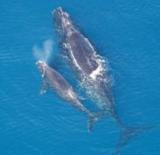
The North Pacific right whale is a very large, robust baleen whale species that is now extremely rare and endangered.
The eastern population of whales that occur off the west coast
of Alaska likely has an abundance of only a few tens of animals,
making it the most endangered marine mammal population in U.S.
waters. Prior to commercial whaling in the North Pacific
the populations in the North Pacific probably were over 20,000
animals. Between the late 1960s and the mid-1990s sightings of
right whales in the eastern North Pacific were rare, widely
scattered, and almost always involved solitary animals.
A significant sighting occurred in the summer of 1996 when a
group of four animals was reported in the southeastern Bering
Sea, and then in 2004 a concentration of whales was found that
included a minimum of 17 whales. In 2002, the first confirmed
sighting in decades was made of a right whale calf. NOAA
Fisheries now conducts extensive research on this small
population to learn more about its population status.
The North Pacific right whale is a large baleen whale. Baleen
whales are characterized by having baleen plates for filtering
food from water, rather than having teeth. The females are
larger than the males and can grow up to 55 feet. The North
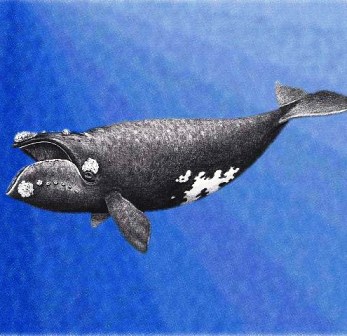
Pacific right whale has a very large head, approximately
one-quarter of its body length, with strongly arched jaws. Right
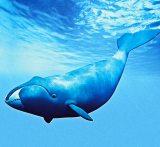
whales are sometimes confused with bowhead whales. Right whales
typically have the obvious wart-like callosities on their heads,
while the skin of bowhead whales is usually smooth.
Right whales are the only baleen whale species in the North
Pacific that lack a dorsal fin altogether. Right whales are also
unique in that all individuals have callosities—roughened
patches of epidermis covered with aggregations of hundreds of
small cyamids that cluster on the callosities. As in other
species of right whales, the callosities appear on its head
immediately behind the blowholes, along the rostrum to the tip
which often has a large callosity, referred to by whalers as the
"bonnet".
There are light, wart-like spots on its head called callosities.
It has a wide body, lacks a dorsal fin, and is mostly black with
some white patches on its underside. Right whales weigh up to
2,000 lb at birth and up to 220,000 lb at maturity, with a life
span over 50 years. Two populations, or stocks, of North Pacific
right whales are currently recognized, one in the western North
Pacific off Russia and the other in the eastern North Pacific
off Alaska.
Right whales prefer coastlines and sometimes large bays, but may
spend a lot of time on the open sea. The Northern right whale
populations are considered to be close to extinction. Right
whales are baleen whales, they filter their food through their
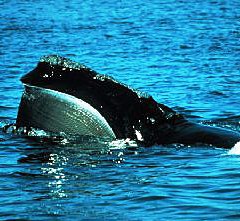
long baleen plates. Right whales open their great mouths and
graze along the surface of the water. Right whales mostly eat
small crustaceans including copepods and small shrimp-like
animals called euphausiids.
Female right whales generally give birth to their first calf at
9-10 years of age. Pregnancy lasts approximately 1 year. The
calf is 13-15 feet and weighs up to 2,000 lb at birth and will
nurse for a year. Mature right whales grow to 45-55 feet and up
to 220,000 pounds (100 metric tons). Populations of right whales
grow slowly because it takes a long time for female right whales
to reach sexual maturity and only give birth to a single calf.
Right whales spend more than 80 percent of their lives
below water. We gain clues about their sub-surface behavior from
underwater microphones (hydrophones), data tags, and from whale
dive times. Right whales have been seen returning to the surface
with mud on their heads, indicating they swam to the ocean’s
bottom during a dive.
The migration patterns of the North Pacific right whale are
unknown. It is believed that they feed during the summer in high
latitudes and move to more temperate areas for the winter.
|