

|
|
There are eight species of whales that frequent the cold and
icy waters of Alaska. The Beluga,
Humpback,
Gray, Orca,
Bowhead, Blue,
Right, and
Minke whales.
Though killer whales, also called orcas, are considered whales
by most people, they are actually members of the dolphin family.
Killer whales are excellent hunters that a wide range of prey,
including fish, seals, and big whales such as
blue whales. Despite their hunting
of other animals, free-ranging killer whales have never been
reported killing a human being.
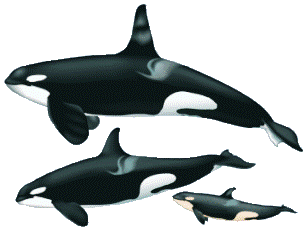
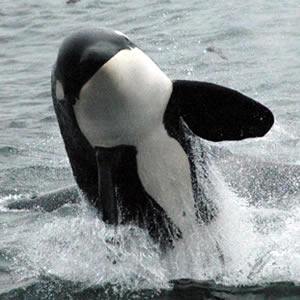
The orca is a stout, streamlined animal. It has a round head
that is tapered, with an indistinct beak and straight mouth
line. The orca, or killer whale, with its striking black and
white coloring, is one of the best known of all the cetaceans.
It has been extensively studied in the wild and is often the
main attraction at many sea parks and aquaria.
An odontocete, or toothed whale, the orca is known for being a
carnivorous, fast and skillful hunter, with a complex social
structure and are found in
all the oceans of the world. Sometimes called "the wolf of the
sea", the orca can be a fierce hunter with well-organized
hunting techniques.. Killer whales are often compared to wolves
because both species are top predators, maintain complex social
relationships, and hunt cooperatively.
Males can grow as large as 32 feet long and weigh 8 to 9 tons.
Females can reach 23 feet in length and weigh up to 4 tons. To
sleep they take catnaps on the surface of the water.
The mouth of the orca is large and
has 46 to 50 conical shaped teeth that point slightly backwards
and inwards. The upper and lower teeth interlock, which aids in
gripping large prey and tearing it into smaller pieces for
easier swallowing. The orca is found in all the oceans of the
world, though they are more abundant in cooler waters. Unlike
some other species of whales, which follow a regular migration
route each year, the orca seems to travel according to the
availability of food. They are one of the few species of whales
that move freely from hemisphere to hemisphere.
Orcas due to their size and color are magnificent creatures.
To some, killer whales look exactly alike however they can be
distinguished from one another by the shape and size of their
dorsal fins, the distinctive grayish-white saddle patches behind
their dorsal fins, as well as distinctive scars, nicks and marks
on their dorsal fins. They often swim in larger pods than due humpbacks, so when you
see one there are usually more near by. Orcas are often spotted
in the Gulf of Alaska and its sheltered bays, where visitors can
also spot other sea mammals such as seals and otters.
Killer whales are social animals that live in stable
family-related groups. During the summer months, you often
see new born calves with their mothers and fathers. Both parents
stay to help care for the young calve. Killer whales display a high level of
care for their offspring. In addition to the mothers, various
pod members (mainly adolescent females) perform most of the care
for the calves. As with most mammals, killer whales are very
protective of their young.
Different killer whale pods "sound"
different. Each pod has their own dialect of sounds. They can
easily recognize their own pod from several miles away based on
the differences in calls.
Orca are curious about humans much like other dolphins are and
have been quickly trained to do tricks when brought into
captivity. Trainers believe them to be much more intelligent
than other kinds of dolphins. They are believed to have all the
senses of humans with the exception of smell.
|