

|
|
There are eight species of whales that frequent the cold and
icy waters of Alaska. The Beluga,
Humpback,
Gray, Orca,
Bowhead, Blue,
Right, and
Minke whales.
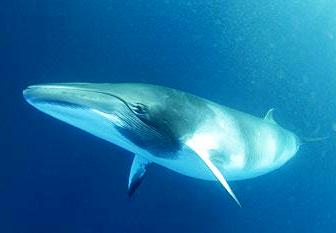
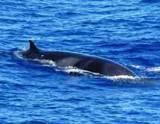
The minke is the smallest of the baleen (filter-feeding) whales
and is found throughout the world's oceans, from the Arctic to
the Antarctic.
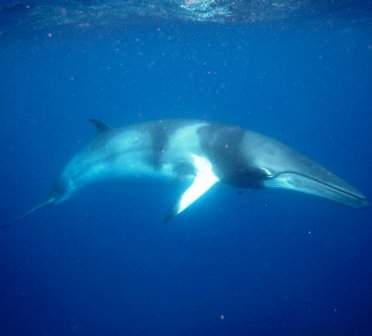
Minke whales grow to be about 25-30 feet long, weighing about
6-7.5 tons. Females are about 2 feet longer than males, as with
all baleen whales. The largest minke whale was about 35 feet
long weighing 9.5 tons. Minke whales have a snout that is
distinctively triangular, narrow, and pointed, which is how the
Minke whale got its nicknames "sharp-headed finner" and "little
piked whale". The minke whale's skin is very dark gray above and
lighter below, sometimes with pale trapezoidal stripes behind
the flippers on the top, and they have a characteristic white
band on each flipper.
Another name for the minke whale is the Little Piked Whale. It
is a fast swimmer, swimming at 16-21 mph, spending very little
time on the surface. They are curious and have been known to
keep up with and even approach ships. This whale can be tricky
for whale watcher to spot, as they are small and easily hidden
in a choppy sea.
Minke whales either travel singly or congregated in small pods
of about 2-3 whales. Minke whales live at the surface of the
ocean in all but polar seas. Minke whales, like all baleen
whales, are seasonal feeders and carnivores, filtering out small
polar plankton, krill, and small fish, even chasing schools of
sardines, anchovies, cod, herring, and capelin.
As with other closely related species, minke whales are
classified as "gulpers" in which the whale lunges at the prey –
often at high speeds with its mouth open and throat grooves
extended. The mouth is then closed expelling the engulfed water
through the baleen plates and then the trapped prey is
swallowed. This behavior occurs either at, or below the surface.
The exact method of trapping an individual prey school varies by
location and individual.
Minke whales
breathe air at the surface of the water through 2 blowholes
located near the top of the head. At rest, minke whales spout
about 5-6 times per minute. The spout of the minke whale is a
very low, almost inconspicuous stream that rises up to 6.5 feet
above the water. Minke whales start to exhaling before they
reach the surface; this minimizes the blow.
Minke whales make the weirdest sounds. They are sort of
metallic and have been called "Star Wars" sounds.
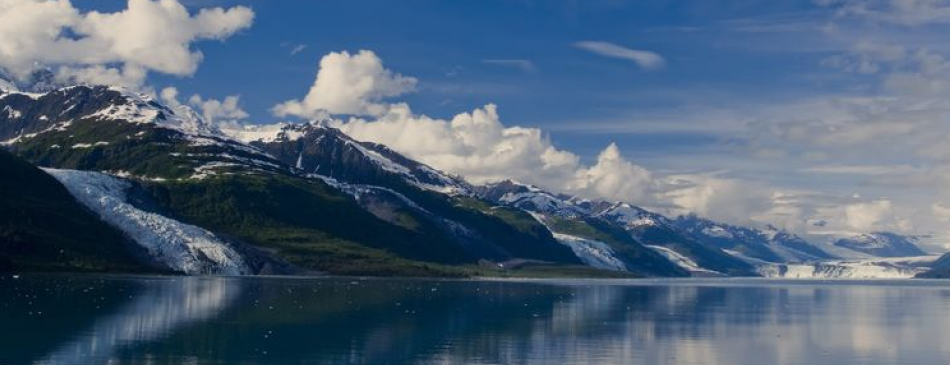
Minke whales spend spring and summer months in Alaska’s Kachemak
Bay, Glacier Bay and Prince William Sound. They are distributed
through out the pacific from Baja California in the winter
months north to the Bering Sea and Chukchi seas in the summer.
At times the minke whales are seen in Glacier Bay, and in the
Gulf of Alaska by cruise ship passengers passing through during
the spring and summer months. They prefer the icy waters in the
northern oceans, more so than other baleen whales. They are
found right up to the edge of the icepack in Polar Regions,
sometimes becoming trapped in the ice fields.
As the larger whales have become depleted and protected the
whalers have begun take the minke whale as a replacement.
Scientists continue to examine the minke populations in the
areas they are harvested. They note that the populations have
actually increased as they have started eating food previously
eaten by the depleted larger whale species. Current populations
are about 100,000 minke whales in the North Pacific. The natural
life span of minke whales is about fifty years.
|