Marine mammals have the same characteristics as all other mammals, but they have adapted to living all or part of their life in the ocean. To keep warm in the ocean, most of them depend on a thick layer of blubber (or fat). They have streamlined bodies to help them swim faster. Many species can stay under water for a long time, but must come to the surface to breathe. To be able to stay under water for long periods, they store extra oxygen in their muscles and blood.
Marine mammals also have more blood than land mammals in proportion to their body sizes, can direct their blood flow to only their vital organs (such as their heart and lungs), and can slow their heartbeat down so they are using less oxygen in a dive. Unfortunately, many marine mammals are considered endangered species and there are still threats to most of their populations, such as illegal hunting, pollution, climate change, and habitat loss. There are five groups of marine mammals: pinnipeds (seals, sea lions, fur seals, and walruses), cetaceans (whales, dolphins, and porpoises), sea otters, sirenians (dugongs and manatees), and polar bears.
The word pinniped means fin or flipper-footed and refers to the marine mammals that have front and rear flippers. This group includes seals, sea lions, and walruses. These animals live in the ocean but are able to come on land for long periods of time. Millions of years ago, the ancestors of pinnipeds lived on land. These were probably weasel or bear-like animals that spent more and more time in the ocean and eventually adapted to this marine environment.
There are three families of pinnipeds: phocids (seals), otariids (sea lions) and odobenids (walruses). There are many different kinds of true seals, but you can always recognize them by looking at their ears and flippers. True seals have ear holes but no external ear flaps. They also have small front flippers and move on land by flopping along on their bellies. At sea, they move their rear flippers back and forth like a fish's tail to propel themselves through the water.
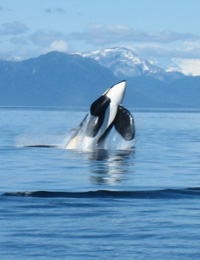
Marine mammals in the cetacean family include whales, dolphins, and porpoises. Although whales spend all their time in the oceans, they are mammals just like us. This means that they are warm blooded, give birth to live young, nurse their young, have traces of hair or fur, and must come to the surface to breathe air through their lungs.
Cetaceans are separated into two groups: toothed and baleen whales. As their name suggests, toothed whales (or odontocetes) have teeth. They also have one opening at their blowhole. There are over 73 species of toothed whales, including sperm and beaked whales, belugas and narwhals, porpoises and dolphins, and even fresh water dolphins that live in rivers. They range in size from the 60-foot (21.1 m) sperm whale to the 5-foot (1.5 m) vaquita. Some toothed whales are quite unusual. For instance, the beaked whales spend most of their time in the deep water and, therefore, are rarely encountered by people, and new species are still being discovered! Some beaked whales are odd looking and often only the males will have teeth. The straptoothed whales have only two teeth, which wrap around the top of their jaws so they cannot fully open their mouths!
The baleen whales (or mysticetes) are the other group of cetaceans. This group includes 11 species ranging in length from the pygmy right whale at 21 feet (6.4 m) to the largest whale, the blue whale at 100 feet (30.5 m). Baleen whales have two blowholes and instead of teeth, have hundreds of rows of baleen plates, which are made of keratin, a substance in our hair and fingernails. The baleen strains out small fish and plankton from the water for food. There are eight species of whales that frequent the cold and icy waters of Alaska. The Beluga, Humpback, Gray, Orca, Bowhead, Blue, Right, and Minke whales.
Sea otters are members of the weasel or mustelid family. Like other members of this family, they have very thick fur. In fact, at 850,000 to one million hairs per square inch, they have the thickest fur of any mammal. Their fur actually consists of two layers, an undercoat and longer guard hairs. This system traps a layer of air next to their skin so their skin does not get wet. Sea otters are usually dark brown, often with lighter guard hairs. Alaskan sea otters tend to have lighter fur on their heads. Sea otters are the smallest marine mammal.
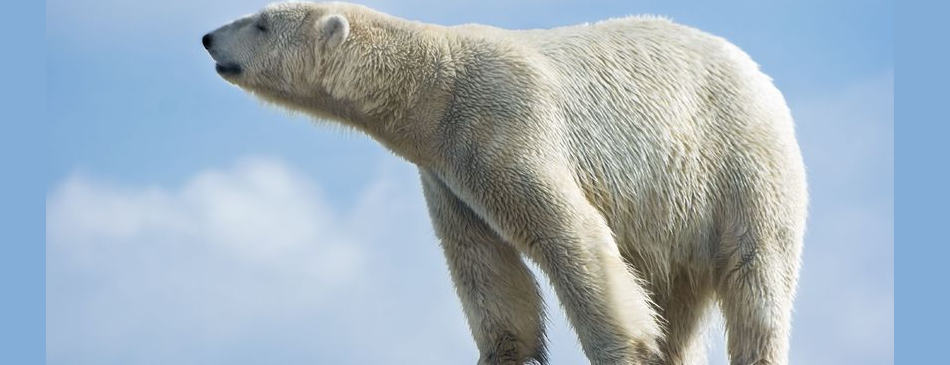
Polar bears are the largest carnivores and a unique symbol of the Arctic. Nineteen populations of polar bears are distributed in Alaska, Canada, Greenland, Norway, and Russia. The world wide population is estimated to be 22,000-25,000 bears. Two populations occur in Alaska: the southern Beaufort Sea stock, shared with Canada; and the Bering Chukchi/Seas stock, shared with the Russian Federation
|
|