

|
|
There are eight species of whales that frequent the cold and
icy waters of Alaska. The Beluga,
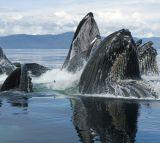
Humpback,
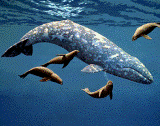
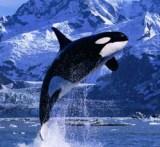
Gray, Orca,
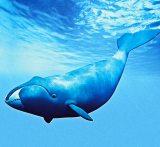
Bowhead, Blue,
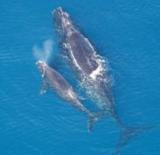
Right, and
Minke whales.
The Humpback Whale is an endangered species, occurring in all
the world's oceans. The humpback whale is a baleen whale that
sings amazing songs. It performs complex and cooperative feeding
techniques. The humpback has a bulky head with bumpy
protuberances (tubercles), each with a bristle. Humpbacks are
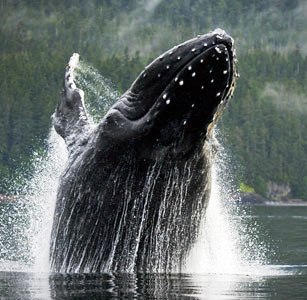
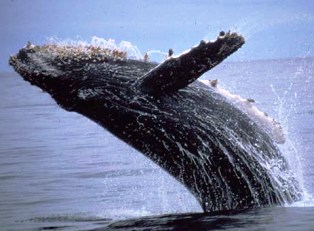
acrobats of the ocean, breaching and slapping the water.
Humpback Whales live in pods and have 2 blowholes. The name
humpback describes the motion it makes as it arches its back out
of the water in preparation for a dive. Graceful and
magnificent, humpback whales inspire awe in young and old alike.
These marine mammals travel great distances to take advantage of
the best breeding grounds and feeding spots. North Pacific
humpbacks, for example, mate and give birth in Hawaii and then
travel to Alaska each summer to feed.
Humpback whales grow to be about 52 feet long, weighing 30-50
tons. The females are slightly larger than males, as with all
baleen whales. The four-chambered heart of the average humpback
whale weighs about 430 pounds! Humpbacks come in 4 different
color schemes, ranging from white to gray to black to mottled.
An average-sized humpback whale will eat 4,400-5,500 pounds of
plankton, krill and small, schooling fish each day during the
feeding season in cold waters.
Humpback whales live at the surface of the ocean, both in the
open ocean and shallow coastline waters. When not migrating,
they prefer shallow waters. They migrate from warm tropical
waters, such as waters off the Florida coast, where they breed
and calve to arctic waters where they eat. Found in all the
world's oceans, most populations of humpback whales follow a
regular migration route, summering in temperate and polar waters
for feeding, and wintering in tropical waters for mating and
calving.
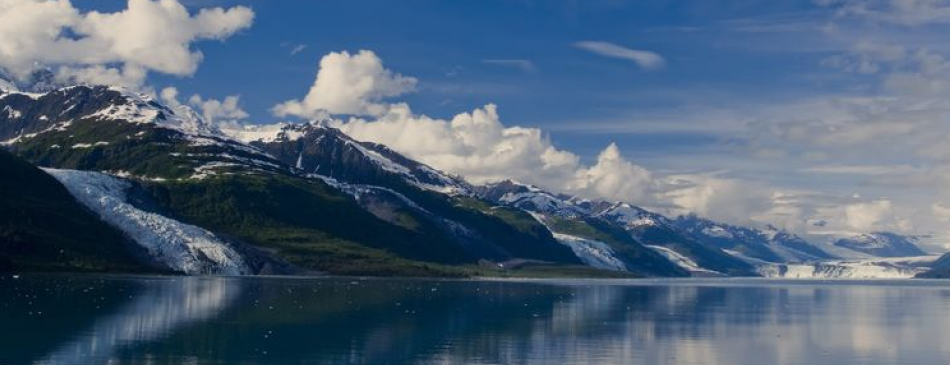
Humpbacks spend the summer in the coastal waters of the
Gulf of Alaska. Passengers on cruise ships, excursion boats and
charter fishing boats may see the whales surfacing and breeching
in the Inside Passage, Prince William Sound, the Kodiak
archipelago and Glacier Bay and Kenai Fjords national parks.
During the summer months you will see Humpback whales in the
Barren Islands between Homer and Kodiak. June and July are the
best months for seeing these enormous whales feeding using
bubble-netting. Over 500 whales make Southeast Alaska's Inside
Passage their home during the months of summer. Juneau is fortunate to have a healthy humpback
whale population every summer, when about 65 whales make their
way back to feed in the nutrient-rich waters.
When a humpback whale dives, the tail rises into the air showing
a distinct shape and coloration unique to each whale. Using
photography, researchers capture this image to identify each
whale.
Humpback whales target very small prey compared to their body
size. They filter-feed primarily on small shrimp-like
invertebrate (zooplankton, often krill or euphausiids) and small
schooling fish such as capelin, herring and sand lance. They
consume about half a ton per day to get their daily requirement
of calories.
Humpback whales have special adaptations that help them to
forage efficiently. A humpback whale’s jaw bones can flex to
maximize the volume of seawater engulfed and when coupled with
14-22 expandable pleats along the lower jaw, a whale can engulf
up to 15,000 gallons of water. Once they have a large mouthful,
they expel the water by straining it through a tightly packed
row of about 400 baleen plates hanging from each side of the
upper jaw, and trapping their prey. Each baleen plate is about
two feet long, and is fringy on the interior of the mouth to
catch the prey, and smooth on the side that faces the outside of
the mouth, so the whale can expel the water efficiently.
Most North Pacific humpbacks that spend their time feeding in
southeastern Alaska breed and calve in Hawaii with a small
proportion migrating to Mexico. The fastest documented
humpback migration from Alaska to Hawaii (2,800 miles) was 36
days. Whales start to arrive in Hawaii in October, numbers
peak in mid February and March and most have left by April.
Calves usually arrive with their mothers, presumably born along
the way, or are born in Hawaii. Occasionally a calf from
the previous year will travel with the mother to Hawaii, now as
a yearling.
|