|
Alaska has an estimated 100,000
glaciers, ranging from tiny cirque glaciers to huge
valley glaciers. There are more active glaciers and ice
fields in Alaska than in the rest of the inhabited
world. The largest glacier is the Malaspina at 850
square miles. Five percent of the state, or 29,000
square miles, is covered by glaciers.
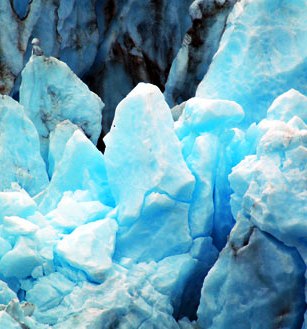
A glacier is a strange and unfamiliar thing. It looks like land, but it flows like water. Glaciers can be larger than a city or even a state, and yet they move constantly, sometimes suddenly, and they can bulldoze straight through mountains. Nothing else looks like a glacier. They’re white, gray, and fluorescent blue. They drape gracefully through the mountains, but they also crack in enormous shards.
Glaciers are rivers of ice that flow from ice packs high in the mountains, where more snow falls than melts. In constant motion, they can move ahead at speeds of several feet a day, or sudden surges of as much as 300 feet. Some glaciers, called receding glaciers, are shrinking due to increased melting or a lack of new snow to feed them.
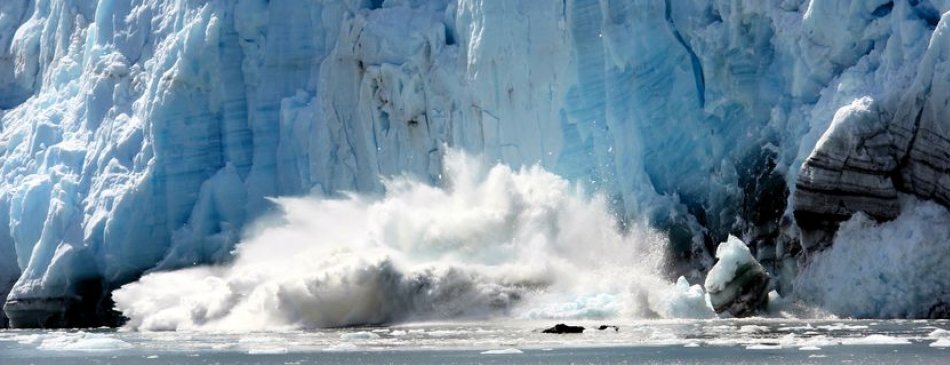
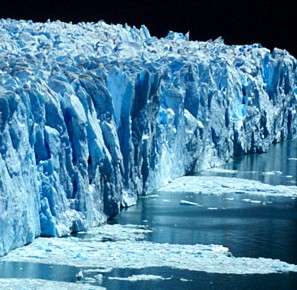
Tidewater glaciers flow to the sea and are found at the head of fjords or inlets which they carved while retreating. Calving occurs when pieces of a tidewater glacier break off and fall into the sea. The creaking sounds associated with calving glaciers and the roar as pieces fall into the sea are as impressive as the visual scene. The beautiful blue color associated with glaciers is created by the density of the ice which absorbs all the colors of the spectrum except blue, which is reflected. Tidewater glaciers are laciers that reach the sea, while freshwater glaciers end in a lake, and valley glaciers end in a valley. Hanging glaciers have only descended part way down a mountainside. Terminal moraine is the ridge of soil that marks the furthest advance of a glacier before it began to recede. Portage Lake was formed behind the terminal moraine of Portage Glacier. Sometimes a dark stripe can be seen running down the middle of a glacier. That is pulverized rock that was pushed up between two merging glaciers.
Glaciers can be dangerous. Snow can mask deep crevasses in glaciers. McKinley mountain climbers rope themselves together not just to reduce the danger of falls from steep slopes but also to reduce the risk of falling into one of these hidden pits in the glaciers on the lower slopes of the mountain. Ice crumbling off the face of a glacier also can be dangerous. A visitor to Exit Glacier several years ago was killed when ice fell on her. Paths at that glacier are now roped off to prevent visitors from so closely approaching the glacier.
With all the glaciers found in Alaska, there are few that should be on your must see list as a tourist:
Prince William Sound Glaciers (Whittier): Less than two hours from Anchorage, the port town of Whittier provides access to northwestern Prince William Sound, one of Alaska’s most beautiful and heavily glaciated waterways.
Kenai Fjords National Park (Seward): Here you find Exit Glacier(one of the few glaciers you can walk right up to) and the magnificent glaciers still carving the fjords, reached only by boats from Seward. This forbidding and untouched area, where mountains shoot a mile high straight out of the sea, is also among the best for seeing marine mammals and birds.
Ruth Glacier (Denali National Park): Forget the traditional image of glacier ice falling into the ocean — this is a chance to land on one of Mount McKinley’s glaciers in a ski plane, get out, and look around. These flights, mostly going from Talkeetna, are among the most spectacular experiences a visitor to Alaska can have.
Juneau Ice Field (Juneau): Helicopters from Juneau fly over the immense ice field that lies beyond the mountains bordering the town. Visitors can just look, or join guided hikes on the ice, or even get in a dog sled and go mushing on the glaciers.
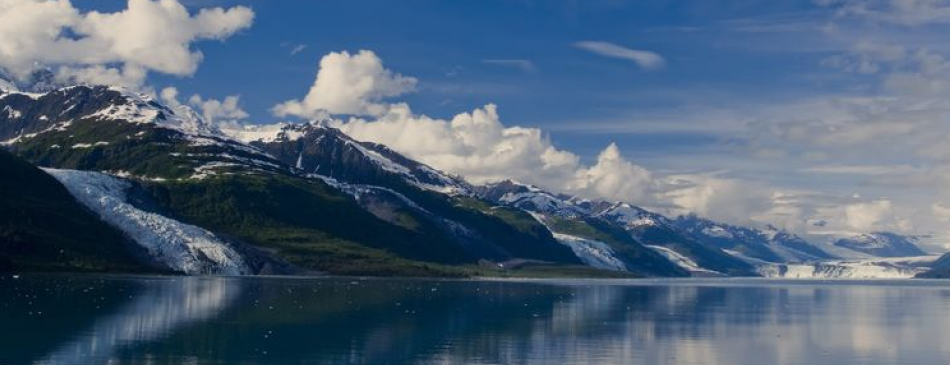
Glacier Bay National Park (Juneau): Glacier Bay is a collection of fjords and inlets, home to 16 active tidewater glaciers, all five species of Pacific Salmon and 25 percent of the total number of bird species in all North America. It is located in the middle of Glacier Bay National Park and Preserve, a 3.2 million acre sanctuary. In just over 200 years, the ice of Glacier Bay has retreated 65 miles. When Captain George Vancouver visited in 1794, the entrance to the Bay was a wall of ice.
|