|
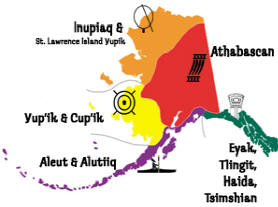
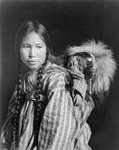
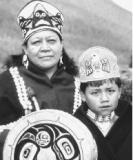
Alaska Natives are the indigenous peoples of Alaska. They include: Aleut, Inuit, Tlingit, Haida, Tsimshian, Eyak, and a number of Northern Athabasca cultures. Alaskan natives in Alaska number about 119,241 (as of the 2000 census). There are 229 federally recognized Alaskan villages and five unrecognized Tlingit Alaskan Indian tribes.
It is important to understand the diversity of native
Alaskan tribes which speak 20 different languages,
belong to five geographic areas, are organized under
thirteen Alaska Native Regional Corporations and have
eleven different cultures. Alaskan natives make up 20%
of the population of the state of Alaska.
Alaska's indigenous people, who are jointly called
Alaska Natives, can be divided into five major
groupings: Aleuts, Northern Eskimos (Inupiat), Southern
Eskimos (Yuit), Interior Indians (Athabascans) and
Southeast Coastal Indians (Tlingit and Haida). These
groupings are based on broad cultural and linguistic
similarities of peoples living contiguously in different
regions of Alaska. They do not represent political or
tribal units nor are they the units Native people have
traditionally used to define themselves.
At the time of contact with Russian explorers in the
mid-18th century, Alaska was occupied by approximately
80,000 indigenous people. The phrase "time of contact"
means the earliest time when a Native group had
significant direct interaction with Europeans. This time
varied for different parts of Alaska; therefore Alaskan
Native groups have had somewhat different historical
experiences through their contact with Europeans and
Americans. In the early spring of 1942, when the Army
Corps of Engineers arrived to begin building the Alaska
Highway, Alaska's population was approximately 73,000.
About half of those residents were Native Alaskans,
members of indigenous groups who inhabited Alaska before
it was colonized by Russia.
Alaska Natives have varied cultures and have adapted to
harsh environments for thousands of years. They are as
far north as Barrow and as far south as Ketchikan.
Today, Alaska Natives account for just over 15 percent
of the total Alaskan population of approximately 648,000
people. Since the 1960s and 1970s, aboriginal autonomy
has rebounded in Alaska. The Alaska Native Claims
Settlement Act of 1971 officially ended native land
ownership claims while creating regional corporations
that administered approximately one-ninth of Alaskan
territory; the shareholders of the corporations are the
native peoples. The legal battles for rights to their
ancestral land began a revitalization of native society
that is evident today.
Stretching like a rocky necklace from Asian to North
America, the Aleutian Islands and the nearby Alaska
Peninsula are the home of the Aleuts. The term "Aleut"
was introduced by Russians and comes originally from the
Koryak or Chukchi languages of Siberia; it appears to
have been quickly adopted by the Aleut people
themselves.
The most diverse group of Alaskan Natives are the
southern Eskimos or Yuit, speakers of the Yup'ik
languages. At the time of contact, they were the most
numerous of the Alaska Native groups. Communities
stretched from Prince William Sound on the north Pacific
Coast to St. Lawrence Island in the central Bering Sea.
The Yuit settled this vast region from west to east
reaching the Kodiak archipelago and Prince William Sound
by about 2,000 years ago.
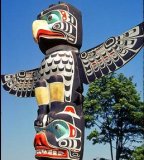
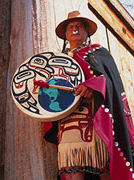
Occupying the islands and mainland of southeast
Alaska are the northernmost groups of the Northwest
Coast cultures; the Tlingit and Haida Indians. They are
well-known for their distinctive art represented in
totem poles and other elegantly carved objects.
The Tlingit and Haida are more similar to Indians
along the coast of present day British Columbia than to
other Alaskan groups. The Tlingit occupied the vast
majority of the area from Yakutat Bay to Portland Canal
while the Kaigani Haida, whose Haida relatives occupied
the Queen Charlotte Island off the north coast of
British Columbia, controlled the southern half of the
Prince of Wales archipelago. The two groups share
similar social and cultural patterns; however, their
languages are unrelated and they have distinct ethnic
identities.
|