|
Personal challenge, physical and spiritual adventures, encounters with other cultures, the prospect of riches, a desire to build different societies -all of these are reasons artists have looked to Alaska for a new frontier. Unlike the rich tradition of Native art in Alaska, which is thousands of years old, European and American artwork of Alaska has a precise and much more recent starting point. These early works were attempts to understand and describe a new and 'exotic' people and place, to fit them into a more familiar version of the world.
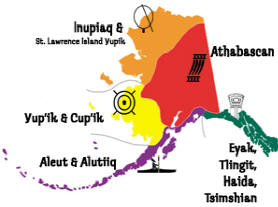
At the time of contact with Russian explorers in the mid-18th century, Alaska was occupied by approximately 80,000 indigenous people. The phrase "time of contact" means the earliest time when a Native group had significant direct interaction with Europeans. This time varied for different parts of Alaska; therefore Alaskan Native groups have had somewhat different historical experiences through their contact with Europeans and Americans. In the early spring of 1942, when the Army Corps of Engineers arrived to begin building the Alaska Highway, Alaska's population was approximately 73,000. About half of those residents were Native Alaskans, members of indigenous groups who inhabited Alaska before it was colonized by Russia.
Up until approximately 1850, due to the difficulty and danger of travel within the region, the only artists with practical access to Alaska were those attached to official exploring expeditions and a few commercial operations. The period immediately following the purchase of Alaska from Russia in 1867 saw a gradual rise in boat traffic to the relatively milder climate of the Territory's South East portions. Regular service from United States ports to Sitka began immediately following the purchase, including sailings out of Portland and San Francisco. John Muir's writings of his visit to the Territory brought wide public attention. The onset of the Klondike Gold Rush spurred a meteoric rise in visitors. Among the thousands of fortune hunters and adventurous tourists were some of the best-known landscape painters of the day.
Early in the 20th century, a new kind of motivation developed for visiting Alaska. The northern wilderness became not just a source of scenery, but a haven for the troubled spirit, and a purer source of inspiration, as was experienced by Rockwell Kent (1882-1971) in 1919 when he and his son spent almost a year on a remote island. Walter B. Styles (in Alaska during the 1880s) was one of the earliest artists to spend a prolonged time in the Territory, and while there he recorded life among the Tlingit Indians. Four artists who made their homes in Alaska for long periods are particular favorites of Alaskans. Known as the 'Alaska Four', they are Sydney Laurence (1865-1940), Eustace Ziegler (1881-1969), Theodore Lambert (1905-1960), and Jules Dahlager (1884-1952). These artists have, over time, taken on an almost mythic status in the minds of long-time Alaskans, and have influenced in varying degrees the way they see their own land.
Alaska's most beloved and renowned resident artist and historical painter, Sydney Mortimer Laurence is best known for his trademark paintings of Mount McKinley. He, perhaps more than any other artist, helped create an image of Alaska as 'the last frontier'. Ziegler was a missionary and painter in Cordova, and his works covered a variety of subjects, from portraits, to Indian villages, to landscapes, as did the works of Dahlager, who also painted in the Cordova region. Ziegler is particularly significant for having depicted Natives neither as exotic, noble primitives, nor as downtrodden examples of a culture under siege. Belmore Browne (1880-1954), an artist often associated with Mount McKinley, was also a mountaineer and writer, and in the early 1900s created numerous depictions of the great mountain as well as Alaska's animals and landscapes.
Johnny Aculiak| Edwin Tappan Adney| George Twok Aden Ahgupuk| Alvin Eli Amason| Saradell Ard| Belmore Browne| Vincent Colyer| Jules Bernard Dahlager| Lockwood De Forest| Frederick Samuel Dellenbaugh| William Franklin Draper| | Henry Wood Elliott| John Fehringer| Claire Fejes| Louis Agassiz Fuertes| Magnus Colcord Heurlin| Norman Jackson| Rockwell Kent| Sydney Mortimer Laurence| Fred Machetanz| Marvin Mangus| Milo Minock| James Kivetoruk Moses| Rie Munoz| Joseph Henry Sharp| James Everett Stuart| John Webber| Kesler Woodward|
|