|
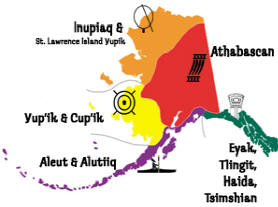
Alaska Natives are the indigenous peoples of Alaska. They include: Aleut, Inuit, Tlingit, Haida, Tsimshian, Eyak, and a number of Northern Athabasca cultures. Alaskan natives in Alaska number about 119,241 (as of the 2000 census). There are 229 federally recognized Alaskan villages and five unrecognized Tlingit Alaskan Indian tribes.
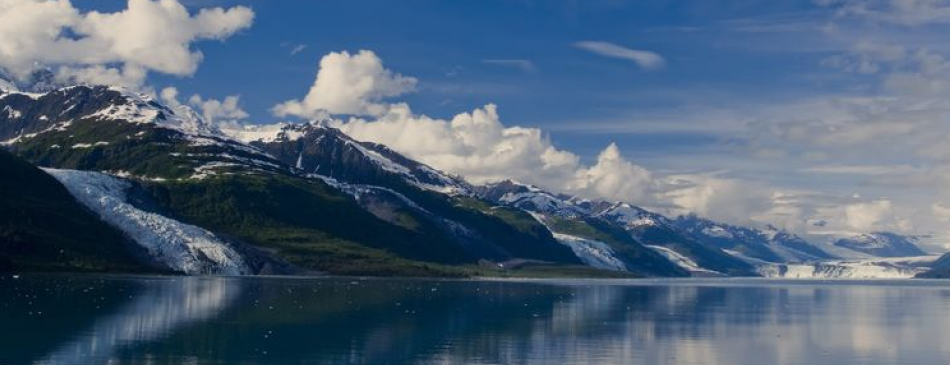
Stretching like a rocky necklace from Asian to North America, the Aleutian Islands and the nearby Alaska Peninsula are the home of the Aleuts. The term "Aleut" was introduced by Russians and comes originally from the Koryak or Chukchi languages of Siberia; it appears to have been quickly adopted by the Aleut people themselves.
Aleut comes from the Russian word Aleuty. The Aleut, are known as Unangan or Unangas in their language, which translates as “we the people.”Aleut homelands include the Aleutian Islands, the Pribilof Islands, the Shumagin Islands, and the far western part of the Alaska Peninsula. The natural marine environment defines subsistence lifestyles and cultures that date back more than 8,000 years ago.
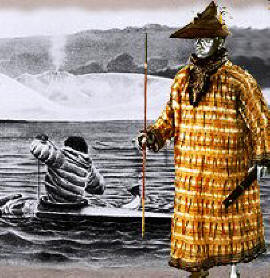
The Aleuts and the Alutiiq differ in language and culture but a commonality was created from the first contact with the Russians in the 18th century that is evident today. The Aleut are expert boat builders and sailors and are well known for their kayaks. They are also known for their very fine baskets. The Aleut language, Unangax, also derives from the Esk-Aleut family.
Aleut settlements were, as a rule, located on bays where there was a good gravel beach for landing skin-covered watercraft. Village locations on necks between two bays were preferred, as such locations provided at least one protected landing for any given wind direction and served as an escape route in the event of enemy attack. A good supply of fresh water nearby was a necessity, as a good salmon stream was indispensable; other considerations were availability of driftwood and access to stone materials suitable for tool- and weapon-making and mineral paints, sea mammal hauling grounds, and an elevated lookout post from which one could watch for enemies and whales.
Aleut society was ranked, with hereditary classes of high nobles, commoners, and slaves. The leaders were recruited from the high nobles or the chiefly elite. This ranking was reflected in allocation of living space within the longhouse and in burials. The "east" and the "above" were the sacred dimensions associated with the creator - Agugux. At dawn Aleut men emerged on the rooftops of their houses and faced the east to greet the day and "swallow light." At sea, Aleut men wore wooden hunting hats. The shape of the headgear indicated a man's rank; a short visor was worn by the young and inexperienced hunters, an elongated visor by the rank-and-file, and open-crown long-visored hats by important mature men.
After the arrival of missionaries in the late 18th century, many Aleuts became Christian by joining the Russian Orthodox Church. One of the earliest Christian martyrs in North America was Saint Peter the Aleut.In 18th century, Russian furriers established settlements on the islands and exploited the people.There was a recorded revolt against Russian workers in Amchitka in 1784. It started from the exhaustion of necessities that the Russians provided to local people in return for furs they had made.
In 1811, in order to obtain more of the now commercially valuable otter pelts, a party of Aleut hunters traveled to the coastal island of San Nicolas, near the Alta California-Baja California border. The locally resident Nicoleño nation sought a payment from the Aleut hunters for the large number of otters being killed in the area. Disagreement arose, turning violent; in the ensuing battle nearly all Nicoleño men were killed. This, along with European diseases, so impacted the Nicoleños, that by 1853, only one living Nicoleña person remained.
Prior to major influence from outside, there were approximately 25,000 Aleuts on the archipelago. Barbarities by outside corporations and foreign diseases soon reduced the population to less than one-tenth this number, The 1910 Census count showed 1,491 Aleuts. In the 2000 Census, 11,941 people reported they were of Aleut ancestry; nearly 17,000 said Aleuts were among their ancestors. Alaskans generally recognize the Russian occupation left no full-blooded Aleuts. When Alaska Natives enrolled in their regional corporations under the terms of the Alaska Native Claims Settlement Act of 1971 (ANCSA), the Aleut Corporation attracted only about 2,000 enrollees who could prove a blood quantum of 1/4 or more Alaska Native (including Aleut).
|