|
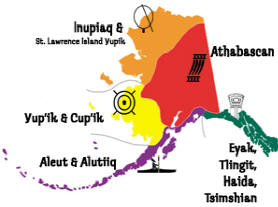
Alaska Natives are the indigenous peoples of Alaska. They include: Aleut, Inuit, Tlingit, Haida, Tsimshian, Eyak, and a number of Northern Athabasca cultures. Alaskan natives in Alaska number about 119,241 (as of the 2000 census). There are 229 federally recognized Alaskan villages and five unrecognized Tlingit Alaskan Indian tribes.
Inuit is a general term for a group of culturally similar indigenous peoples inhabiting the Arctic coasts of Alaska, the eastern islands of the Canadian Arctic, Labrador, and the ice-free coasts of Greenland. In Eskimo Inuktitut, the language of the Inuit people, "Inuit" means "the people". The English word "Eskimo" is a Native American word which is widely believed to mean "eater of raw meat" (although this meaning is disputed). Many Inuit consider the word Eskimo offensive, but it is still in general usage to refer to all Eskimo peoples, though it has fallen into disuse throughout Canada, where Canadians use the term Inuit.
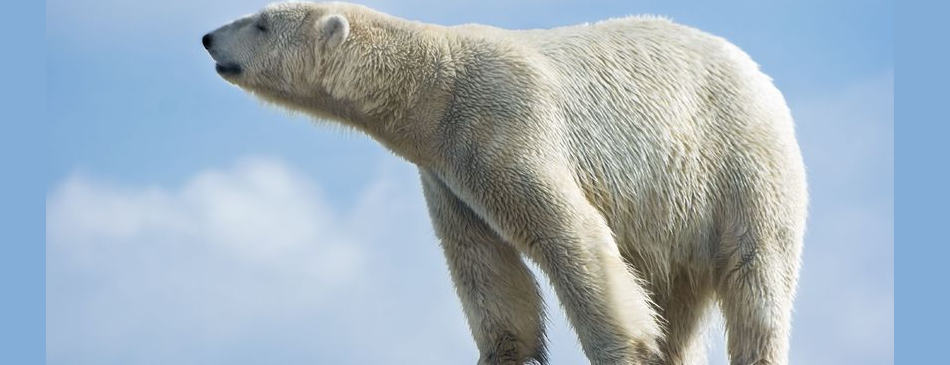
The Inuit were traditionally hunters and fishermen, living off of Arctic animal life. They hunted by preference whales, walruses, caribou and seals, although polar bears, musk oxen, birds and any other edible animal might be taken in a pinch. The Arctic has very little edible vegetation, although Inuit did supplement their diet with seaweed.
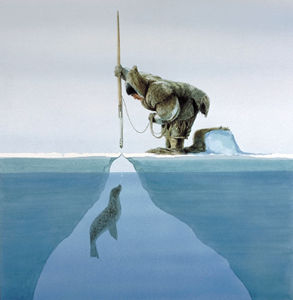
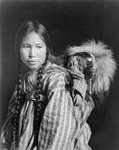
Sea animals were hunted from single-passenger, covered seal-skin boats called qajait (singular qajaq) which were extraordinarily buoyant, and could easily be righted by a seated person, even if completely overturned. Because of this property, the Inuit design was copied - along with the Inuit word - by Europeans who still make and use them under the name kayak. Inuit also made umiaq - larger, open boats made out of skins and bones for transporting people, goods and dogs. The Inuit used several kinds of harpoons and spears. Large harpoons were used to hunt the walrus. Smaller spears were used for hunting small animals and birds. Wooden spear throwers were used to increase the spear's power. All spear throwers were individually made for the hunter. The length of the thrower was equal to the distance between the hunters forefinger and his elbow. This have the hunter and extra arm joint. In the winter, Inuit would also hunt sea mammals by making holes in the ice and waiting for the air-breathing seals and walruses to use them when they needed air. According to Inuit tradition, they learned to do this by observing the polar bear, who hunts by seeking out holes in the ice and waiting nearby. Warm clothing was important to the Inuit tribes. Sealskin was usually wore in the summer. In the winter caribou skin was worn. Caribou skin was light weight yet very warm. Clothing was also made of other skins including those of musk oxen, polar bears, and birds. The women skinned the animals and made the clothing. The women used bones for needles and gut thread. Both men and women wore hooded tunics and trousers over long boots. the women's tunics were made very large so she could carry her baby inside the tunic. On land, the Inuit used dog sleds (in Inuktitut, qamutiit, singular qamutiq) for transportation. The husky dog breed comes from Inuit breeding of dogs for transportation. A team of dogs in a fan formation (and not bound together in a line like horse teams) would pull a sled made of animal bones and skins, and in some southern areas a bit of wood, over the snow and ice. They used landmarks to navigate, and possessed a comprehensive native system of toponymy. Where natural landmarks were insufficient, the Inuit would erect an inukshuk to compensate. Inuit industry relied almost exclusively on animal hides and bones, although some tools were also made out of worked stones, particularly the easily-worked mineral known as soapstone. Walrus ivory was a particularly essential material, used to make knives. Some Inuit who lived near the tree-line also had native woodworking traditions. Inuit made clothes and footwear from animal skins, sewn together using needles made from animal bones and threads made from other animal products.
|