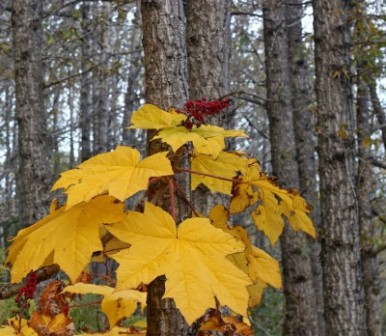
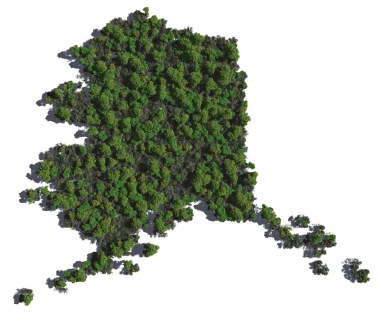
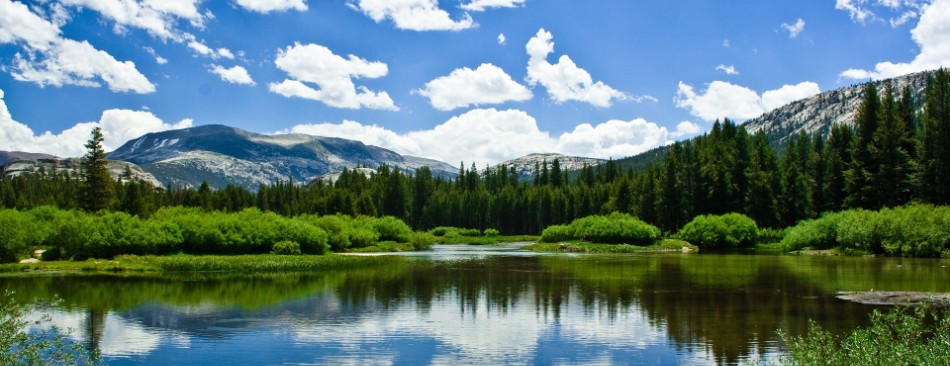
Ecosystems in Alaska range from grasslands, mountains, and tundra to thick forests, in which Sitka spruce (the state tree), western hemlock, tamarack, white birch, and western red cedar dominate the landscape.
Black spruce are found in wet soils and bogs. They are found in peats, clays, and loamy soils. Often in pure stands. The small size of black spruce limits lumber production. The lowest branches take root by layering when deep snows bend them to the ground, forming a ring of small trees around a large one. These trees are often easily distinguished from white spruce by their thin, scraggly appearance and the black hairs found on the twigs. Black spruce is one of the most important trees to the Dena’ina Indians. Their word for spruce, “Ch’vala” is also the name for tree. All three species of spruce are called by this name, however, they differentiate growth forms (which often differentiates species) by various names.
White Spruce are one of the most common and commercially valuable trees in Alaska. It is a very important tree that supports a variety of wildlife. The tallest White Spruce are generally found along rivers, where running water thaws the soil. These trees are seldom found where permafrost is close to the surface. On average, White Spruce live to be 100 - 200 years old.
Sitka Spruce, Alaska's state tree, is the largest of all spruce, with a tall and straight trunk from a buttressed base and a broad, open, and conical crown of horizontal branches. Throughout southeast Alaska, Prince William Sound, Kodiak Island, Kenai Peninsula, and up the northern edge of the range extends just north of Girdwood, you can find Sitka spruce. This is the primary timber tree in Alaska because of its size and for the fact that it produces high-grade lumber for many uses. Sitka spruce was used in airplanes (including “The Spruce Goose”) and is used in musical instruments such as guitars. Sitka Spruce makes up more than 20 percent of the hemlock-spruce coastal forests of Alaska. The largest old growth trees in southeast Alaska have trunk diameters exceeding 8 feet and are 500 – 700 years old! As you make the drive form Cooper Landing to Seward, look for the change from forests dominated by White Spruce and Lutz Spruce to those of Sitka Spruce.
On the Kenai Peninsula, there are natural hybrids between White Spruce and Sitka Spruce, which are called Lutz Spruce. These hybrid trees can be recognized by their leaves and cones, which are intermediate to the parent species. The Lutz Spruce is found where the ranges of White Spruce and Sitka Spruce meet and/or overlap.
Western Hemlock is the largest of the hemlock species. It has a long, slender, and often fluted trunk. The crown is narrow, conical, and made up of short, slender, horizontal or slightly drooping branches. The tip of the tree, or the leader, is slender, curved and drooping.
Mountain Hemlock is found in moist, coarse, or rocky soils. It can be found anywhere from sheltered valleys to exposed ridges. This is a characteristic species of high mountains. In Alaska, they can be found up to 3,000 – 3,500’ in elevation. They vary greatly in size from a large tree at lower altitudes to a dwarf shrub at treeline. Hemlock trees provide shelter and food for wildlife, and generally are considered unimportant for commercial uses.
Mountain Alder is found on stream banks, bogs, and areas with moist soils. Native Americans made a red dye from the powdered bark of the Mountain Alder. Alder twigs and buds are an important winter food source for ptarmigan. In the fall and winter, the seeds or nutlets are eaten by many songbirds.
Paper Birch is one of the most easily distinguished trees with a narrow, open crown of slightly drooping to nearly horizontal branches, and conspicuous white bark. Paper Birch is sometimes found as a shrub. In Alaska, there are 3 geographical varieties of Paper Birch in Alaska, and they hybridize with each other wherever their ranges meet. Native Americans used the Paper Birch for the making of canoes and many types of containers. The bark should never be peeled from a live tree, as this leaves permanent, ugly black scars. Birch trees produce a bitter tasting chemical known as salicin (similar to aspirin), to deter moose and other animals from browsing on their branches.
Balsam Poplar is the northernmost hardwood tree, as it can be found in scattered groves on the Arctic Slope. Artists and crafts-people use the bark in carvings. Balsam poplar is a large tree with a narrow, open crown of upright branches and fragrant, resinous buds with a strong balsam odor. Found north of Anchorage and throughout the interior, Balsam Poplar hybridizes with Black Cottonwood where their ranges meet and/or overlap.
|
|