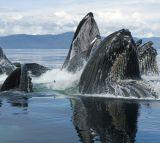
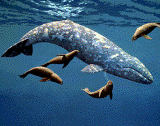
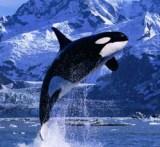
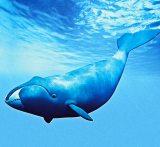
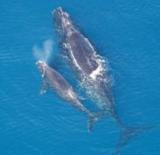
There are eight species of whales that frequent the cold and icy waters of Alaska. The Beluga, Humpback, Gray, Orca, Bowhead, Blue, Right, and Minke
whales.
The distinctive whale known as the beluga whale is one of several beaked whales that inhabit the Aortic. North Atlantic, and North Pacific Oceans Russian explorers named the beluga whale when they spotted them in the Bering Sea. Beluga means "the white one". At birth, beluga whales are dark blue-gray in color, measure 3-5 feet long, and weigh 90-130 lbs. The color gradually lightens, usually turning white by age 5 or 6. Adult beluga whales average 13-15 feet in length and weigh between 2,500 and 3,500 pounds.Males reach sexual maturity between four and seven years, while females mature at between six and nine years. The beluga can live more than 50 years.
Belugas are robust-bodied and have a blubber layer which can be as much as 5 inches thick. They are muscular creatures with a small rounded head, a short beak, and are quite mobile in comparison to other whales. The belugas have a narrow ridge that runs down the rear of their backs, which allows them to swim freely under floating ice. Also, the beluga is the only whale that can bend its neck. This helps them to maneuver easily and catch prey, using their 34 to 40 teeth, not for chewing, but for grabbing and tearing their prey, which is then swallowed whole. Belugas use sound to find their prey. They also use sound to communicate and navigate by producing a variety of clicks, chirps and whistles.
Two populations of beluga whales occur in Alaska. The Cook Inlet population occurs in the inlet and Shelikof Strait region, although wanderers have been seen east to Yakutat Bay and to Kodiak Island. Belugas of the Bering Sea population range throughout the Bering, Chukchi, and Beaufort seas.
In the summer beluga whales migrate in pods into Turnagain arm and may be observed along the shore. Areas where beluga whales concentrate, such as shallow tidal flats, larger river mouths, estuarine areas, and certain areas where the level of human related disturbance is low, provide a necessary combination of physical and biological features that facilitate feeding, breeding, and nursing. Additionally, ice in these regions in the colder months may provide important barriers to beluga predators.
Belugas prey on a wide variety of animals, including octopus, squid, crabs, shrimp, clams, mussels, snails, sandworms, polychaetes, and various fish such as cod, herring, smelt, flounder, sole, sculpin pollock ,lamprey, lingcod and salmon. In the spring, CookInlet belugas primarily eat eulachon (a.k.a. hooliganor candlefish), and switch primarily to salmon in the summer. In the fall and winter, when eulachon and salmon numbers are low, belugas diversify their diet and spend more time feeding in deeper waters.
In 1849, while constructing the first railroad between Rutland and Burlington in Vermont, workers unearthed the bones of a mysterious animal in the town of Charlotte. Buried nearly 10 feet (3.0 m) below the surface in a thick blue clay, these bones were unlike those of any animal previously discovered in Vermont. Experts identified the bones as those of a beluga. Because Charlotte is over 150 miles (240 km) from the nearest ocean, early naturalists were at a loss to explain the bones of a marine mammal buried beneath the fields of rural Vermont.
On June 9, 2006, a young beluga carcass was found in the Tanana River near Fairbanks in central Alaska, nearly 1,700 kilometers (1,100 mi) from the nearest ocean habitat. Belugas sometimes follow migrating fish, leading Alaska state biologist Tom Seaton to speculate that it had followed migrating salmon up the river at some point in the prior fall.
Belugas are highly sociable whales. Groups of males may number in the hundreds, while mothers with calves generally mix in slightly smaller groups. When pods aggregate in estuaries, they may number in the thousands. This can represent a significant proportion of the entire population and is when they are most vulnerable to hunting. Pods tend to be unstable, meaning that they tend to move from pod to pod. Radio tracking has shown that belugas can start out in a pod and within a few days be hundreds of miles away from that pod.
Mothers and calves form the beluga's closest social relationship. Calves often return to the same estuary as their mother in the summer, meeting her sometimes even after becoming fully mature. Belugas can be playful; they may spit at humans or other whales. It is not unusual for an aquarium handler to be drenched by a beluga whale. Some researchers believe that spitting originated with blowing sand away from crustaceans at the sea bottom. Unlike
most whales, beluga whales are capable of swimming
backwards
|
|